

This Is the Table
What Remains When the Traditions Are Stripped Away

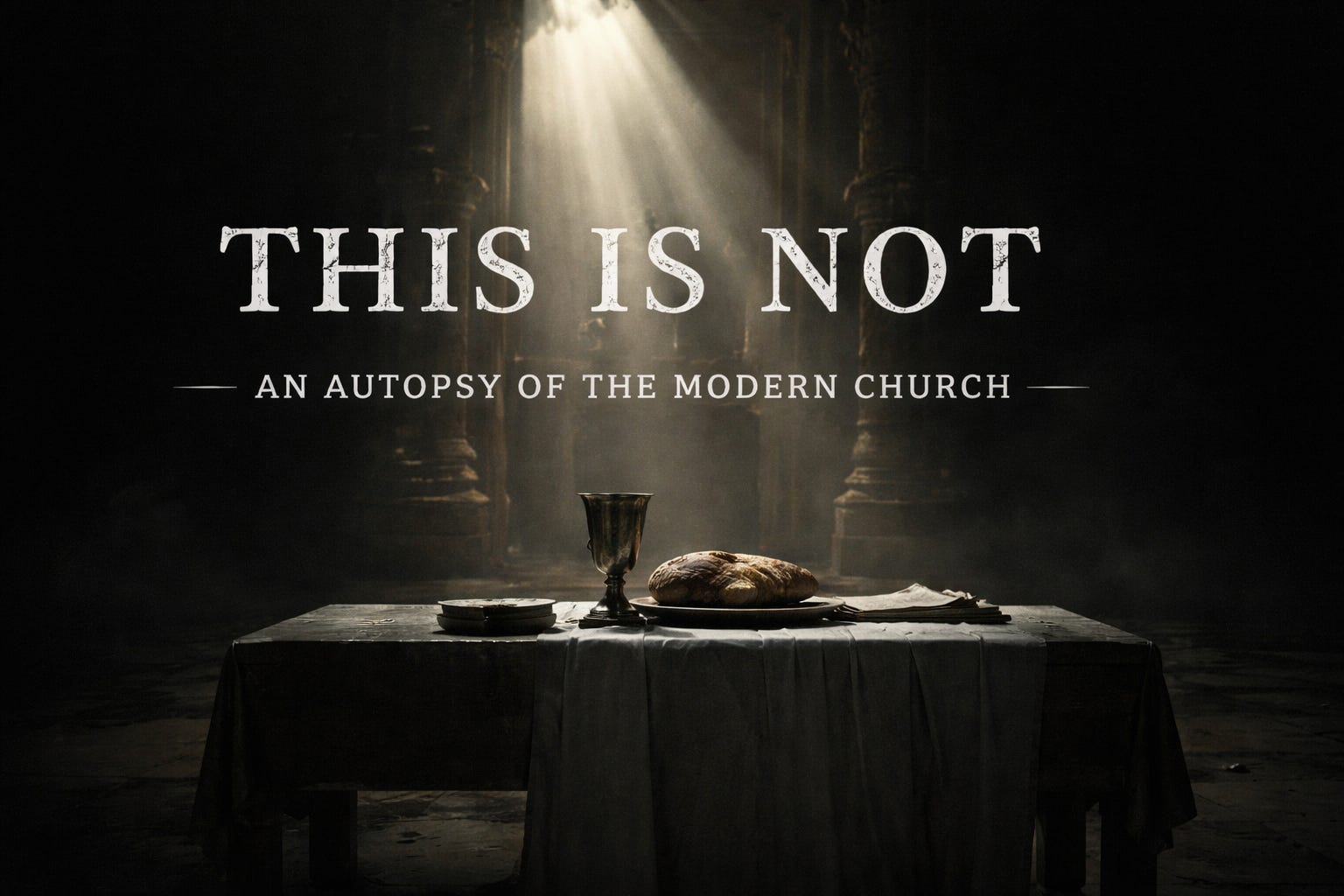
This is the final article in a series of autopsies.
This Is Not Church — The introduction
This Is Not a Feast — The table
This Is Not Teaching — The sermon
This Is Not a Profession — Professional ministers
This Is Not Belonging — Membership
This Is Not God’s House — Buildings
This Is Not an Economy — Money
This Is Not Worship — Church music
This Is Not Ministry — Programs
This Is Not Unity — Division
This one examines what remains.
I spoke with a dear childhood friend last night. We hadn’t connected in a while, just owing to getting busy and all. But when we did, we found ourselves united over the same longings and the same lament over institutions. The same ache for being known and knowing others.
I didn’t mention it to him at the time, but I thought about the theme song from a show that was very popular when we were growing up:
Making your way in the world today
Takes everything you’ve got
Taking a break from all your worries
Sure would help a lot
Wouldn’t you like to get away?
Sometimes you wanna go
Where everybody knows your name
And they’re always glad you came
You wanna be where you can see
Our troubles are all the same
You wanna be where everybody knows your name
Each of us has experienced different yet the same forms of alienation from the structure. Different churches. Different denominations. Different experiences. But the same longing. The same ache. The same desire to be where everybody knows your name.
This is what we’re after. Not a better system. Not a reformed institution. A place where everybody knows your name. Where you’re always glad they came. Where troubles are shared. Where presence matters. Where relationship is the point.
This is what the table offers.
I’ve done the best I can to remove all the paint and varnish from this table.
The one I found at that yard sale. The ridiculous-looking one with legs removed, covered in layers of paint and decoupage. The one I flipped over to discover beautiful walnut wood underneath.
It took months. The table sat in my garage, legs removed, waiting. I’d work on it in the evenings, on weekends, whenever I could find time. The process was slow. Deliberate. Sometimes frustrating.
First came the chemical stripper. Thick, toxic stuff that smelled like a chemistry lab. I’d brush it on, wait for it to bubble and lift, then scrape away layer after layer. White paint. Blue paint. Yellow paint. Each one revealing another underneath. The decoupage came off in chunks—butterflies, ducks, flowers, all that decorative nonsense that someone thought would make it beautiful.
But the paint wasn’t the worst part. The varnish was. Multiple coats of it, each one harder than the last. Some areas had been varnished so many times that the stripper barely touched it. I’d apply it, wait, scrape, apply again, wait, scrape. Over and over. The same spot. The same stubborn layer.
Then came the sanding. Hours of it. Days of it. I started with coarse grit—60, then 80, then 120. The orbital sander humming, dust everywhere, my arms aching. I’d sand until I thought I was done, then flip it over, see another spot I’d missed, sand some more. Then move to finer grits—150, 220, 320. Each pass revealing more of the grain, more of what was underneath.
I used steel wool for the tight corners the sander couldn’t reach. My fingers cramped. My back hurt. But I kept going because every time I removed another layer, I saw more of what was actually there.
The tools accumulated. Stripper. Scrapers of different sizes. Sandpaper in every grit. Steel wool. Rags. Mineral spirits. Tack cloths. A shop vac to clean up the mess. A respirator because the dust and fumes were no joke.
And the mess. Oh, the mess. Paint chips everywhere. Dust coating everything. Stripper drips on the concrete floor. Rags soaked in chemicals. The garage looked like a disaster zone.
But slowly, methodically, layer by layer, the junk came off. The paint. The varnish. The decoupage. All of it. Gone.
And underneath? Beautiful walnut wood. Rich grain. Deep color. The kind of wood that shows its age in the most beautiful way. The kind of wood that tells a story. The kind of wood that was meant to be seen, not hidden under layers of paint and decoupage and varnish.
The real thing.
I’m done talking about what it’s not. I’m done scraping away the layers. I’m done with the autopsy.
It’s dead. We know why. We’ve examined it. We’ve named it. We’ve traced its parts and understood how they worked together to create something that looked alive but wasn’t.
But now—life.
We are now, expectantly and with hope, focused singularly on what it is, what it should be, what it can be.
What Do We Call It?
I’ve been calling it “the table” throughout these articles. It’s a metaphor. A picture. A way of talking about something that’s hard to name.
But I’ve also used the word “ekklesia.” Not to be pretentious with Greek. Not to sound scholarly. But because it’s the actual word the New Testament uses, and it hasn’t been corrupted by two thousand years of institutional baggage the way “church” has.
Ekklesia (pronounced ek-klay-see-uh, or if that’s new to you, just think “ek-lee-see-uh”) means “called-out ones.” A people called together. Not a place. Not an institution. A people.
But here’s the thing: The name doesn’t matter. Not really.
You can call it “ekklesia” if that helps. You can call it “the table” if that picture works. You can reclaim the word “church” after emptying it of its baggage. You can call it “gathering” or “assembly” or “community” or any number of other words.
What matters is what the thing is.
Not what it’s called. Not what it looks like. Not how it’s structured. Not what system it follows.
What it is.
So I’ll keep calling it “the table.” Not because I’m anchoring you to a specific location or piece of furniture. The table is a shortcut. A way to express the idea. A picture that captures what ekklesia actually is—a place of presence, relationship, mutual participation, knowing and being known.
Throughout this series, I’ve held out the table as the way forward. It’s been the consistent image. The accessible metaphor. The thing that makes sense when all the systems don’t. So I’ll stick with it here.
But know that when I say “the table,” I mean ekklesia. The called-out ones. God’s gathered people. The body of Christ. The household of God. All of it.
And what it is cannot be prescribed. It cannot be systematized. It cannot be institutionalized.
It is God’s work done by the Spirit in God’s gathered people.
What the Table Is
The New Testament doesn’t leave us guessing. It tells us what ekklesia is—and when I say “the table,” this is what I mean.
Jesus said, “I will build my ekklesia” (Matthew 16:18). Not “I will build my institution” or “I will build my organization.” His ekklesia. Something he builds. Something that belongs to him.
Paul called it “the ekklesia of God, which he obtained with his own blood” (Acts 20:28). Not something we create. Not something we own. Something God purchased. Something God possesses.
The New Testament describes ekklesia in multiple ways, each one revealing something essential:
Ekklesia is the body of Christ. “For just as the body is one and has many members, and all the members of the body, though many, are one body, so it is with Christ” (1 Corinthians 12:12). “And he is the head of the body, the ekklesia” (Colossians 1:18). Christ is the head. The ekklesia is the body. Not a building. Not an institution. A body. With many members. Each one necessary. Each one connected. Each one functioning.
Ekklesia is the household of God. “So then you are no longer strangers and aliens, but you are fellow citizens with the saints and members of the household of God” (Ephesians 2:19). Not a corporation. Not a business. A household. A family. Fellow citizens. Members of a household.
Ekklesia is God’s temple. “Do you not know that you are God’s temple and that God’s Spirit dwells in you?” (1 Corinthians 3:16). “In him you also are being built together into a dwelling place for God by the Spirit” (Ephesians 2:22). Not a building made of stone. A temple made of people. God’s Spirit dwelling in his people. The people themselves are the dwelling place.
Ekklesia is the bride of Christ. “Christ loved the ekklesia and gave himself up for her” (Ephesians 5:25). Not an organization to be managed. A bride to be loved. Christ’s sacrifice. Christ’s beloved.
Ekklesia is a royal priesthood. “But you are a chosen race, a royal priesthood, a holy nation, a people for his own possession” (1 Peter 2:9). Not a class of religious professionals. A priesthood of all believers. All chosen. All royal. All holy. All God’s possession.
Ekklesia is Spirit-indwelt. “God’s Spirit dwells in you” (1 Corinthians 3:16). Not in a building. In you. In his people. “You are being built together into a dwelling place for God by the Spirit” (Ephesians 2:22). Built together. By the Spirit. A dwelling place for God.
The Spirit manifests in each member. “To each is given the manifestation of the Spirit for the common good” (1 Corinthians 12:7). Each given. The Spirit manifesting. For the common good.
The Spirit teaches. “The anointing that you received from him abides in you, and you have no need that anyone should teach you” (1 John 2:27). Not just human teachers. The Spirit. “We have the mind of Christ” (1 Corinthians 2:16). Not through human wisdom. Through the Spirit. The mind of Christ.
These aren’t metaphors we can spiritualize away. They’re descriptions of what ekklesia actually is. A body. A household. A temple. A bride. A priesthood. Spirit-indwelt. Spirit-taught. Spirit-empowered. All of these, together, showing us what God’s gathered people are.
And this body has many members. “For just as the body is one and has many members, and all the members of the body, though many, are one body, so it is with Christ” (1 Corinthians 12:12). One body. Many members. Not uniform members. Different. Distinct. But one. “For as in one body we have many members, and the members do not all have the same function, so we, though many, are one body in Christ, and individually members one of another” (Romans 12:4-5). Many members. Different functions. One body. Members of one another.
“The eye cannot say to the hand, ‘I have no need of you,’ nor again the head to the feet, ‘I have no need of you.’ On the contrary, the parts of the body that seem to be weaker are indispensable” (1 Corinthians 12:21-22). No member unnecessary. No member dispensable. All needed. All important. “If one member suffers, all suffer together; if one member is honored, all rejoice together” (1 Corinthians 12:26). Connected. Interdependent. When one suffers, all suffer. When one rejoices, all rejoice. This is how a body functions.
“Now you are the body of Christ and individually members of it” (1 Corinthians 12:27). You are the body. Not you will be. Not you should be. You are. Now. The body of Christ.
So if the table is a body, a household, a temple, a bride, a priesthood—how does it actually function?
How the Table Functions
The New Testament shows us how ekklesia gathered and functioned. Not as a suggestion. Not as an ideal. As a pattern. As what actually happened.
“They devoted themselves to the apostles’ teaching and the fellowship, to the breaking of bread and the prayers” (Acts 2:42). Teaching. Fellowship. Breaking bread. Prayers. Together. Devoted. Not occasional. Not optional. Central.
“And day by day, attending the temple together and breaking bread in their homes, they received their food with glad and generous hearts” (Acts 2:46). Day by day. In their homes. Breaking bread. Glad and generous hearts. Not once a week. Not in a special building. Daily. In homes. Around tables.
This is how the table gathered. This is the pattern. Not because it was commanded in a formula, but because this is what naturally emerged when God’s people gathered. This is what happened. This is what worked. This is what the Spirit produced.
Paul described it this way: “When you come together, each one has a hymn, a lesson, a revelation, a tongue, or an interpretation. Let all things be done for building up” (1 Corinthians 14:26). Each one has something. Each one brings something. Each one participates. Not one person performing. Not everyone watching. Everyone participating. Everyone building up.
“You can all prophesy one by one, so that all may learn and all be encouraged” (1 Corinthians 14:31). All can participate. All can learn. All can be encouraged. “All things should be done decently and in order” (1 Corinthians 14:40). Order. But not control. Decency. But not passivity. Structure. But not hierarchy.
When ekklesia gathers, everyone has a face. Everyone has a voice. Everyone has a place.
When someone says, “I’m not sure that 1,000 years is literal,” what happens? Do the others throw them out? Do they create a new gathering? Do they divide?
Or do they keep eating together? Keep talking. Keep listening. Keep knowing and being known.
Because at the table, the person matters more than the position. The relationship matters more than the agreement. The presence matters more than the doctrine.
But this doesn’t mean anything goes. The table handles disagreement relationally. When someone says something concerning, you don’t immediately divide. You talk. You listen. You ask questions. You share your conviction. You bear witness. You pray. You continue in relationship. You give time. You give space. You give grace.
Because at the table, you have time. You have relationship. You have presence. You can discern together. You can wait. You can see if this is a momentary confusion or a fundamental departure. You can discover what’s actually happening rather than reacting to a position.
Obviously, I can’t spell out every kind of disagreement. I can’t tell you how to determine if it’s trivial or actually hazardous to the very nature of the table. These are the kinds of things I generally think that God’s people, indwelt by God’s Spirit, in relationship with other believers, are well equipped to discern and handle. “The anointing that you received from him abides in you, and you have no need that anyone should teach you” (1 John 2:27). “We have the mind of Christ” (1 Corinthians 2:16). “If any of you lacks wisdom, let him ask God, who gives generously to all without reproach” (James 1:5).
God’s people, indwelt by the Spirit, in relationship with one another, are equipped to discern. Not perfectly. Not infallibly. But relationally. In presence. Together.
When someone opens the text, it’s not because it is their assignment, but because it has been living in them all week. Another pauses the reading and asks a question no sermon would allow. Someone else says, “I don’t know,” and the room does not panic.
The Scriptures are not mishandled. They are handled together. Not because there’s no one qualified to teach, but because teaching happens through the body. “And he gave the apostles, the prophets, the evangelists, the shepherds and teachers, to equip the saints for the work of ministry, for building up the body of Christ” (Ephesians 4:11-12). Teachers equip. The body builds itself up. Not one person teaching everyone. The body teaching itself.
Memory surfaces. Another passage is recalled. A lived experience reframes a word. Someone senses a dissonance with Christ’s character, and the room slows down. Someone else, known for their understanding of Scripture, speaks with weight. Not because they have a title. Because they have demonstrated wisdom. Because the body recognizes their gift.
Understanding does not arrive polished. It accumulates.
This is not chaos. It is communal discernment.
What forms here is slower, but sturdier. Less impressive, but harder to manipulate.
And when decisions need to be made, when guidance is needed, when care must be coordinated, the table has elders. Not as a separate class. Not as professionals. As those recognized by the body for their character, wisdom, and maturity. “Let the elders who rule well be considered worthy of double honor” (1 Timothy 5:17). “Appoint elders in every town” (Titus 1:5). “Shepherd the flock of God that is among you” (1 Peter 5:2). Elders. Plural. Recognized by the body. Serving the body. Not ruling over it, but serving it. “Not domineering over those in your charge, but being examples to the flock” (1 Peter 5:3).
The table has structure. It has order. It has those who serve. But it’s the structure of relationship. The order of presence. The service of the body. Not the structure of systems. Not the order of control. Not the hierarchy of positions.
When someone brings a song, there is no oversight of style, genre, talent, or singing voice. Only the Spirit’s leading in his people.
This participatory gathering creates something specific: mutual care. The New Testament is filled with “one another” commands. Not “one to another.” Not “some to others.” One another. Mutual. Reciprocal. All to all.
“Love one another. Just as I have loved you, you also are to love one another. By this all people will know that you are my disciples” (John 13:34-35). This is how the world knows. Not by our buildings. Not by our programs. By our love for one another.
Through that love, we serve one another (Galatians 5:13). We bear one another’s burdens (Galatians 6:2). We encourage and build one another up (1 Thessalonians 5:11). Not serving the institution. Not serving the program. Serving one another.
We confess our sins to one another and pray for one another (James 5:16). We show hospitality without grumbling (1 Peter 4:9). We teach and admonish one another in all wisdom (Colossians 3:16). We speak the truth in love (Ephesians 4:15). Not one person teaching everyone. Not hiding. Not pretending. One another teaching one another. One another knowing and being known.
These “one another” commands aren’t just individual ethics. They’re how the body functions. They’re the pattern of ekklesia. They’re what happens when God’s people gather. Not as programs. Not as assignments. As the natural expression of the body. As what emerges when people are present with one another. As what the Spirit produces in his people.
This is how the table functions. Not through hierarchy. Not through programs. Through one another. Through mutual love. Through mutual service. Through mutual care. Through the body functioning as a body.
And this mutual care extends to material needs. “And all who believed were together and had all things in common. And they were selling their possessions and belongings and distributing the proceeds to all, as any had need” (Acts 2:44-45). Together. All things in common. Distributing to those in need. Not a program. Not a budget. Mutual aid. Response to need.
“If anyone has the world’s goods and sees his brother in need, yet closes his heart against him, how does God’s love abide in him?” (1 John 3:17). “Do not neglect to do good and to share what you have” (Hebrews 13:16). “Bear one another’s burdens, and so fulfill the law of Christ” (Galatians 6:2).
Giving is not an obligation. It is a response. A response to need you can see. A response to people you know. A response to situations you understand. Not a response to a budget. Not a response to a campaign. Not a response to an institution.
A response to need.
This is not an economy. This is mutual aid. This is the body functioning. This is the New Testament pattern.
What the Table Requires
The table requires presence. The table requires limits. The table requires face-to-face relationship.
The table makes division difficult because it makes relationship easy. It makes abstraction difficult because it makes presence easy. It makes proclamation difficult because it makes patience easy.
The table requires presence because you can’t abstract someone into a position when you’re eating with them.
The table requires limits because you can’t manage hundreds or thousands of people at a table. You can’t orchestrate their participation. You can’t control their contributions.
The table requires relationship because that’s how needs are known. That’s how care is given. That’s how the body functions.
The New Testament shows ekklesia meeting in homes. “The ekklesia in their house” (Romans 16:5). “The ekklesia in her house” (Colossians 4:15). “The ekklesia in your house” (Philemon 1:2). Not in special buildings. In homes. Around tables. In presence. In relationship.
This body, this household, this temple—it creates something specific.
What the Table Creates
The table creates unity.
The table doesn’t eliminate differences. It preserves them within relationship. The table in different places will reflect different contexts, different cultures, different expressions. They will be different. They will be distinct. They will reflect where they are and who they are.
But more than that, the table accommodates faithful differences. Different ways of reading Scripture—some emphasizing literal interpretation, others seeing types and shadows, all seeking to understand God’s word. Different theological emphases—some focusing on God’s sovereignty, others on human responsibility, both true, both needed.
Different expressions of faith—some more expressive, others more contemplative, both valid. Different experiences of God—some through suffering, others through joy, both real. Different questions—some wrestling with doubt, others with certainty, both welcome. Different struggles—some with sin, others with suffering, both met with grace.
Different gifts—some teaching, others serving, others encouraging, all needed. Different perspectives—shaped by different lives, different stories, different journeys, all valuable.
These differences don’t mean unfaithfulness. They mean the body is functioning. They mean the Spirit is working through different people in different ways. They mean the table is big enough, flexible enough, relational enough to hold them all.
The table doesn’t require uniformity. It doesn’t require agreement on every detail. It doesn’t require the same understanding of every passage. It doesn’t require the same theological framework.
The table doesn’t create uniformity. It creates unity. Not through sameness. Through presence. Through relationship. Through knowing and being known.
This doesn’t mean there are no essentials. It doesn’t mean anything goes. The essentials are established in Scripture—the gospel, the deity of Christ, the resurrection, the authority of Scripture. But at the table, these essentials are recognized and affirmed relationally, not enforced institutionally. When someone fundamentally denies the resurrection, or rejects Christ’s deity, or abandons the gospel—these things become clear in relationship. In presence. In conversation. Over time. Not through a doctrinal statement. Not through a membership test. Through knowing and being known.
But let’s be honest—most disagreements aren’t that. Most disagreements are about how to read a passage, or what emphasis to place on a doctrine, or how to apply a principle. And at the table, these can be held in tension. They can be discussed. They can be lived with. Because the person matters more than the position. The relationship matters more than the agreement.
Jesus prayed for this: “that they may all be one, just as you, Father, are in me, and I in you, that they also may be in us, so that the world may believe that you have sent me” (John 17:21). Unity. Not uniformity. Oneness. Not sameness. So the world may believe.
Paul pleaded for it: “I appeal to you, brothers, by the name of our Lord Jesus Christ, that all of you agree, and that there be no divisions among you, but that you be united in the same mind and the same judgment” (1 Corinthians 1:10). No divisions. United. Same mind. Same judgment.
“Maintain the unity of the Spirit in the bond of peace. There is one body and one Spirit—just as you were called to the one hope that belongs to your call—one Lord, one faith, one baptism, one God and Father of all” (Ephesians 4:3-6). One body. One Spirit. One hope. One Lord. One faith. One baptism. One God. Unity in diversity.
The table creates mutual aid. The body functioning. Needs met. Burdens shared. Care given. Not through budgets. Not through campaigns. Through seeing need. Through sharing. Through bearing burdens.
The table preserves what the traditions obscure. Presence elevates what the traditions displace. Relationship maintains what the traditions destroy.
What the Table Replaces
The table is the participatory feast, not the institutional ritual. The table is where each one brings something, not one voice monopolizing. The table is where the body functions, not a professional class.
The table is relational belonging, not institutional gatekeeping. The table is where God dwells in his people, not in buildings. The table is where needs are met directly, not through institutional budgets.
The table is participatory music, not performance. The table is relational care, not programs. The table is where unity is preserved through presence, not division through systems.
This is what Jesus meant when he warned against “the traditions of men.” Not that traditions are inherently wrong, but that they obscure what matters. They elevate what shouldn’t be elevated. They displace what should be central.
The table is what remains when those traditions are stripped away. It’s what was there all along. It’s the pattern the New Testament describes. It’s what the Spirit produces when God’s people gather in presence, in relationship, in mutual participation.
Not through systems. Not through structures. Not through institutions.
Through the table.
What This Is
This is God’s work done by the Spirit in God’s gathered people.
This is the pattern established in the New Testament.
This is presence. This is relationship. This is mutual participation.
This is the table.
This is ekklesia.
This is what remains when the traditions are stripped away. This is what was there all along. This is what the traditions obscured and displaced.
This is the real thing.
The Invitation
If you hold out hope that God has something different for his people, then I’d like to ask you to consider: What would you have to strip away of your own deeply held and passed down traditions? And what might they have been obscuring for so long?
Ekklesia is not a formula. It’s not a blueprint. It’s not a model to replicate.
It’s a place. A presence. A relationship. A knowing and being known.
It’s what God’s people do when they gather. When they eat. When they share life. When they bear one another’s burdens. When they speak truth in love. When they encourage one another. When they build one another up.
It’s what happens when the Spirit works through his people, not through programs and hierarchies.
And that’s enough.
Greetings Bo,
The LORD bless you for sharing how the Holy Spirit has caused you to strip away the workings of man and their fleshly ways,of human reasoning after their traditions, which has not truly represented how the Lord Jesus Christ desires HIS Body, His Bride to function, as Paul clearly testifies of.
Your usage of stripping away the many layers of garbage which hide the true value of the wood on the table is quite a creative way in expressing how man has laid so many unbiblical layers which hides the One True meaning of the Body of Christ.
Jesus prayed to the Father, in John 17:22 "And the Glory which thou gavest me I have given them; that they may be ONE even as we are ONE.
When the LORD through His Holy Spirit opened this verse up to me, I wept because, HE desires us to be that close to Him, and One with Him as He is with the Father.
Sadly I have not heard this from any pulpit through the 48 years I've been with the Lord.
It truly is a love story. And it assisted me in understanding the Scripture in Song of Solomon; Son 2:5 "Stay me with flagons, comfort me with apples: for I am "Sick of Love". Also found in Son 5:8.
And what you call the Table, I think what Jesus said "He is the Bread of Life, and we are to partake of Him, and the "Cup" is the cup of suffering"........ all for the purpose of Phil 3:10 "That I may know HIM, and the power of His resurrection, and the fellowship of His sufferings, being made conformable unto His Death".
The true Body of Christ is too share this together, to be one as He is one with the Father. To Love one another as HE Loves us, as you have written, to share burden's, to give as the need arises, to support one another in Truth, as He represents it, but tragically main-stream Christianity does not represent this in any measure and has not for nearly 200 yrs.
As you stated, and I confirm with you, those who are truly Born-again by the Power of God, through His Holy Spirit, we instantaneously BECOME members of His Body, His true Church. There is not other mandate. What churches have done is that they demand we be signed up member's of their 'System" and when we do not, we will not benefit as those who are "signed up member's", which means they represent a "Cult", where there is truly NO Freedom whatsoever.
Sorry, I am done now.
It's a blessing to read your postings, and I have agree with them all.
The Lord bless you abundantly.......
“And day by day, attending the temple together and breaking bread in their homes, they received their food with glad and generous hearts” (Acts 2:46)”
Bo, I really enjoyed this series and I hope some day it is a book ☺️. My question is related to the verse above since they continued to attend temple and gathered in ekklesia. Yes, the church is dead and I imagine the temple was too since it was aligned with power from what I know. Jesus continued to attend temple, so in your view, is there still a place for organized religion, even if the ekklesia gatherings happen in each others homes?