

This Is Not a Feast
An Autopsy of the Modern Lord’s Table

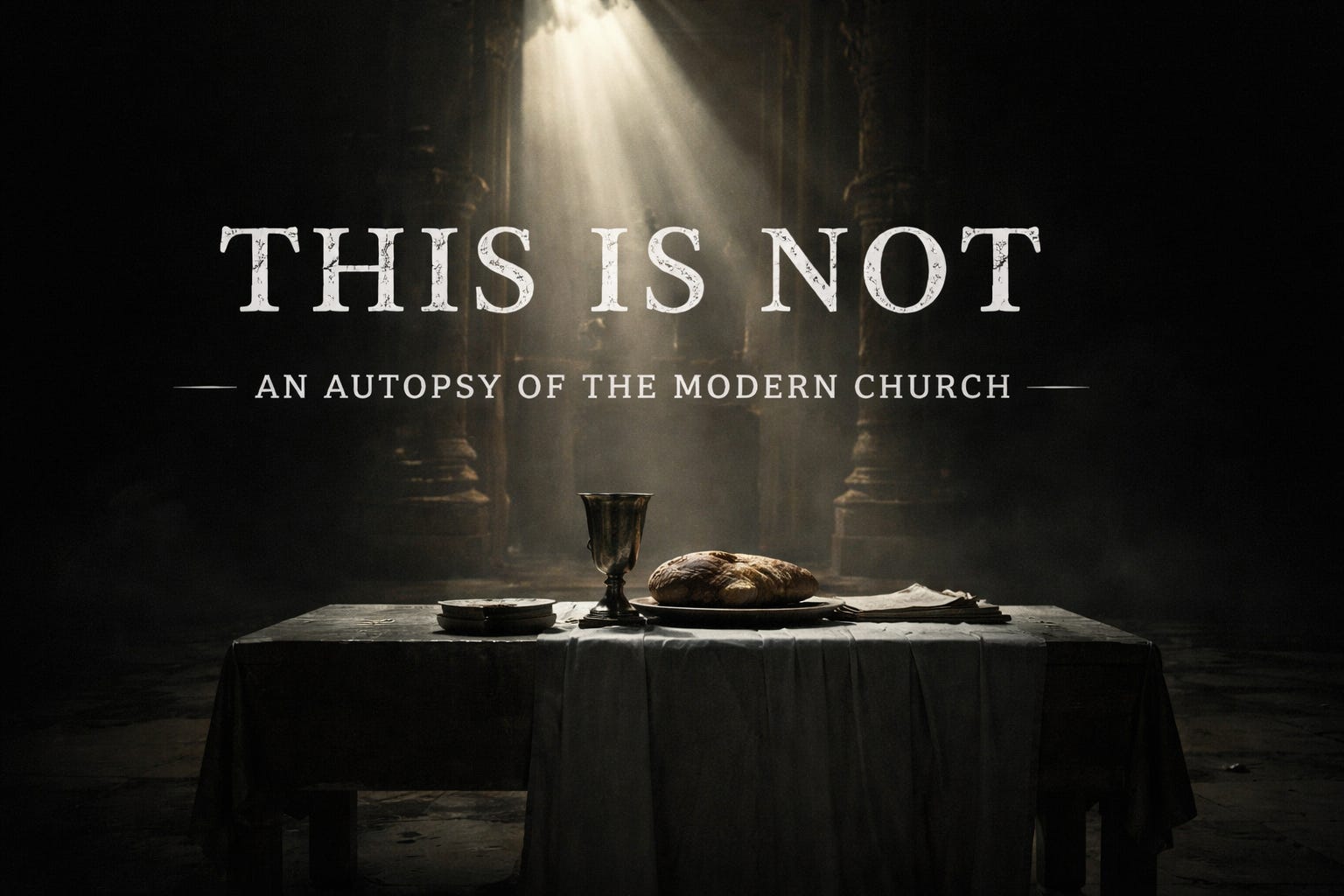
Sunday Morning, a Few Years Ago
I woke up early enough to beat the parking rush.
The room filled with sound first. Songs performed by a leader and a band, rehearsed, polished, projected. I sang along, mostly listening. My posture was already decided for me.
Then came the sermon. Fifty minutes. Carefully crafted. Slide deck synced. Movie references chosen with precision. The text was handled well. Connections were drawn I appreciated and would have made myself.
But I was still sitting. Still silent. Still receiving.
No dialogue. No interruption. No risk.
And then the pivot.
“The Lord’s Table.”
From the front, it was declared brilliantly. New Testament references. Rich language. The word feast spoken with confidence.
And then we shuffled.
Single file.
Down the aisle.
Tear off a meager scrap of bread.
Grab a shot glass of juice.
Gluten-free crackers offered as a side accommodation.
And something in my mind finally broke.
A feast?
What in the hell is feast-like about this?
This wasn’t irony. It was farce. A comic tragedy so normalized no one flinched.
Minutes later, we were dismissed and scattered like roaches into parking lots, scrambling toward real lunches, excited to discuss what a great sermon it had been.
And I knew it.
I’m in the matrix. I know I am.
The modern “table” is not a table. It is a prop.
We took something literal, embodied, and demanding and collapsed it into a symbol so small it can be swallowed without consequence. A cracker fragment. A plastic thimble. A drive-by transaction slipped into a service whose real center never has to yield an inch.
In the New Testament, the table is the thing.
In modern practice, it is the illustration of a thing.
That is not continuity.
That is replacement.
We did not spiritualize the table. We neutralized it.
A table in Scripture is not a metaphor. It is a meal.
Meals take time.
Meals require coordination.
Meals force proximity.
Meals expose difference.
Meals cannot be rushed without becoming something else.
The moment the meal is miniaturized, speed becomes possible.
The moment speed becomes possible, control returns to the stage.
The table slows everything the modern church is designed to accelerate.
So it had to be reduced.
A meal is participatory by nature. A ritual can be observed.
Think about how you eat with people you love.
You sit.
You wait.
You pass.
You receive.
You listen while chewing.
You speak while others chew.
You notice who hasn’t been served.
You notice who dominates the space.
You notice who withdraws.
No one is elevated.
No one performs.
No one is hidden.
A meal makes spectators impossible.
That is precisely why it does not survive institutional scale.
“But my small group does this.”
Yes. And that is the point.
The fact that genuine table fellowship has been outsourced to the margins tells you everything. We allow the table only where it cannot threaten the main event.
The main gathering must remain:
efficient
predictable
stage-centered
voice-controlled
audience-safe
The table cannot exist under those conditions.
So we exile it to homes and call that faithfulness, while protecting the monologue from ever being questioned.
“It isn’t practical for 400 people.”
Exactly.
That is not a logistical problem.
That is a theological confession.
The New Testament table assumes limits.
The modern gathering assumes scale.
When the table exposes the lie of scale, the table is sacrificed.
The sermon never is.
Ask yourself which one the New Testament actually warns about abusing.
The cracker and the cup are not symbols of unity. They are evidence of displacement.
Paul says the table can cease to be the Lord’s table if practiced wrongly.
Notice what he does not say.
He does not warn about:
wrong words
wrong posture
wrong elements
wrong administrator
He warns about:
humiliation
exclusion
inequality
failure to discern the body
You cannot humiliate someone with a wafer you never had to wait for.
You cannot exclude someone from a sip already portioned.
You cannot dominate a space where participation has been stripped away.
The modern table is safe because it is toothless.
What kinds of “one another” are even possible?
At a table:
you bear with one another
you defer to one another
you confess to one another
you reconcile with one another
you notice one another
you serve one another
you submit to one another
you discern one another
From a stage:
you are addressed
corrected
inspired
managed
dismissed
One forms a body.
The other manages a crowd.
The uncomfortable truth
We did not shrink the table because theology demanded it.
We shrank it because the table contradicts the system we built.
A real table:
resists hierarchy
exposes inequality
disrupts performance
limits growth
refuses spectatorship
So we kept the language, reduced the practice, and told ourselves nothing important was lost.
But the New Testament disagrees.
The table was never an accessory.
It was the place where Christ ruled in the most dangerous way possible.
Face to face.
Hand to hand.
Bread to bread.
And that is precisely why it had to go.
A test, not a theory
So don’t argue with this.
Test it.
Hold a meal.
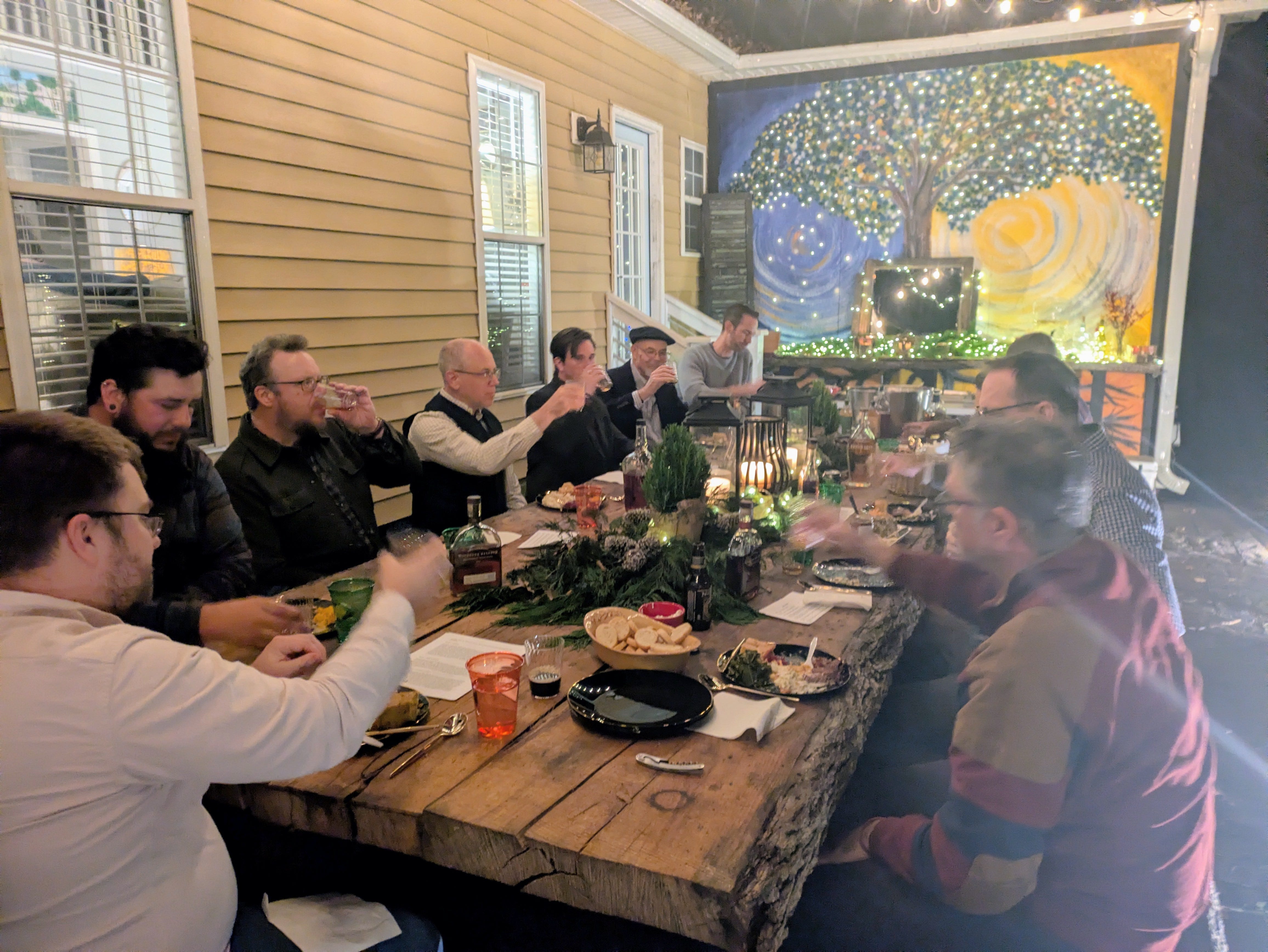
Spread out some tables.
Twelve people. Fifteen. Eighteen. Whatever fits the room and the food.
Eat.
Drink.
Thank God out loud for the table and for the air in your lungs.
Then watch what happens.
Let someone share a teaching. Not a sermon. A few minutes. Something God has impressed upon them.
Watch someone else do the same.
Ask if everyone knows a song.
If they do, sing it together from the table.
No microphones. No lights. No stage.
Then listen.
Watch how the conversation moves.
Notice who speaks and who waits.
Notice how laughter interrupts theology.
Notice how stories surface that would never survive a monologue.
Notice how exhortation happens sideways, not from above.
And then ask the dangerous question.
If you are able to entertain the radical notion:
Is this ekklesia?
Is it possible that God can actually use each of us for the building up of one another?
Without a budget.
Without a seminary degree.
Without a soundboard.
Without a building.
Without a zero-turn mower and a leaf blower.
Is it possible the Spirit does not require our infrastructure to speak?
That Christ does not need our staging to rule?
That the body might actually function without being managed?
Because if the answer is even possibly yes, then the problem with the table was never theology.
It was control.
The table doesn’t need defending.
It needs to be set.
And once it is, the question will no longer be whether this is church.
The question will be why we ever accepted a substitute.
Next in the series: This Is Not Teaching — examining how the monopolized sermon replaces the participatory table.
You hit about a dozen nails squarely on the head here.
Reading through it, I can't help wonder if those still in the institutional church give much, if any, thought to the points you make. How many understand one-anothering? Do they recognize the emptiness of being passive attendees at the main event (love that term)? Does it dawn on them that communion in the brick church bears no resemblance to the Last Supper? I could go on and on, but you covered the base nicely.
Your closing question points to the heart of the matter. Do we even understand what we're passing up?
It's interesting that the use of small cups came from a (mistaken) view that common cups would spread disease. We've made the Lord's table something manageable in a way that sitting at table with real loaves and decanters of wine (all right, grape juice if people worry about alcohol) couldn't be. And our churches "celebrate" the Lord's table more like a funeral than a feast.