

This Is Not Ministry
An Autopsy of Program-Driven Church Life

This is the eighth in a series of autopsies.
The first examined the table: This Is Not a Feast. The second examined the sermon: This Is Not Teaching. The third examined professional ministers: This Is Not a Profession. The fourth examined membership: This Is Not Belonging. The fifth examined buildings: This Is Not God’s House. The sixth examined money: This Is Not an Economy. The seventh examined worship: This Is Not Worship.
This one examines ministry.
They are not isolated failures.
They are one tangled system.
Over the two prominent church structures I’ve participated in, I’ve done it all. Deacon. Worship team. Benevolence. Bus captain (that’s an entirely different article). Children’s church pastor. Teen Sunday school teacher. Adult Sunday school teacher. Care group leader. Adult education committee. Men’s ministry leader. And no doubt many others I can’t or choose not to remember.
However you want to slice or dice up people into demographic groups, I’ve seen it and participated in it. The silos in which we divide people up is staggering. As is the expectation that when we toss all of these people back together, we’re confused that they do not talk to or relate to one another.
In my business, this makes perfect sense to me. I’m a software engineer by trade. One thing that has fascinated me is the difference between large and small organizations.
Large organizations, by necessity, create all kinds of technical silos. Security team. Data operations. DevOps. IT. Development. Architecture. What I’ve witnessed is that a natural kind of antipathy develops between the groups. A tribalism. A “they just don’t get it like we do” kind of vibe.
I presently work for a startup and am in a situation to be able to build out a multidisciplinary team of engineers. Rather than offload specialties to one person, I’m intentionally looking for people who know a little about a lot of stuff we need, while realizing that they tend to excel in one area. And as we gather as a team to solve problems, that doesn’t mean that the engineer with a stronger architecture leaning tells everyone how it’s going to be. We just naturally solve our problems as a team, looking for some direction in the group from the person who seems to demonstrate a gifting in that area, while the others probe, ask questions, and refine their own skills in that area.
The difference is not just size. It’s structure. It’s how we organize. It’s what we create when we divide.
The Program Model
Modern ministry is built on programs. Children’s ministry. Youth ministry. Men’s ministry. Women’s ministry. Discipleship programs. Evangelism programs. Small groups. Bible studies. Outreach programs. Recovery programs.
Each with its own curriculum, schedule, leader, budget, space, and materials.
Now, you might ask: Can’t there be a relational program?
The answer is: Not really.
Programs have structure. They have schedules. They have curriculum. They have designated leaders, spaces, and times. Relationship is organic. It responds to need. It emerges from presence. It happens when it happens. It doesn’t follow a schedule or curriculum. It doesn’t require a designated leader or space.
When you structure relationship, you’ve created something else. You’ve created a program. And programs, by their nature, replace organic relationship with structured interaction. They replace presence with schedule, response with curriculum, mutuality with designated roles.
Each program claims to build relationships. And within the program structure, relationships do form. But the structure itself determines the kind of relationship. Program-based relationships serve the program. They fit the schedule. They follow the curriculum. They maintain the structure. But relationship, in the New Testament sense, serves the need. It responds to presence. It emerges from the body. It doesn’t require a program to exist.
Ministry becomes programmatic. Not because programs are inherently evil, but because programs, by their structure, cannot be relational in the way the New Testament describes. Programs are scheduled; relationship is organic. Programs are structured; relationship is situational. Programs are curriculum-driven; relationship is need-driven.
These are incompatible.
The Necessary Acknowledgment
Now, let’s acknowledge something important.
Just because something does not appear in Scripture doesn’t make it bad in and of itself. Electricity doesn’t appear in Scripture. Driving to a gathering doesn’t appear in Scripture. These aren’t bad.
Creating age-specific events doesn’t have to be bad intrinsically. The question is not whether age-specific events are mentioned in Scripture.
The question is: What do programs do to the table? What do they do to the normal means of grace? What do they do to ekklesia? What do they do to following Jesus?
Programs are structured by design. They have schedules, curriculum, designated leaders, designated spaces, designated times. This structure is not accidental. It is intentional. And this intentional structure creates something that is counter to the table. It creates separation where the table requires presence. It creates division where the table requires unity. It creates management where the table requires relationship. It creates programs where the table requires the body functioning together.
This is what I aim to demonstrate in this article: Programs are structured by design to create something that is counter to the table. They separate the body. They fragment relationships. They replace organic ministry with programmatic ministry. They require the system. They serve the system. And in doing so, they work against the very thing they claim to serve.
The Scale Problem
Here is the critical point: There is virtually no way that any of this program happens apart from the acceptance of large scale.
Programs are a response to scale. When you have 200 people, you cannot know everyone. When you have 200 people, you cannot address everyone’s needs. When you have 200 people, you cannot function as a body. So you create programs. Children’s ministry to handle the children. Youth ministry to handle the youth. Men’s ministry to handle the men. Women’s ministry to handle the women.
Programs are a management tool. They manage scale. They organize large numbers. They create structure for what cannot function organically.
But the New Testament pattern assumes limits. It assumes a size where each one can speak, each one can be heard, each one can be known, each one can participate. Programs are not necessary at that size.
At the table, you don’t need children’s ministry. You need children at the table. At the table, you don’t need youth ministry. You need youth at the table. At the table, you don’t need men’s ministry or women’s ministry. You need men and women at the table. The body functions as a body. Without programs. Because the scale allows it.
Programs are a concession to scale. They are a substitute for what cannot happen at scale. But they are not the solution. They are the problem.
The question “How else do you minister to 200+ people?” assumes the problem is the number. But the problem is the scale. The New Testament pattern doesn’t assume you need to minister to 200+ people in one gathering. It assumes limits. It assumes a size where the body can function. Programs allow you to minister to more people by managing scale. But the body allows you to minister to people by being the body. These are not the same thing. Programs manage what cannot function organically. The body functions organically because the scale allows it.
How Programs Disrupt the Table
The table is the normal means of grace. It requires the body to be present together. All ages. All stages. All gifts. All needs. At the table, children learn from adults. Adults learn from children. Youth learn from elders. Elders learn from youth. The table is where the body functions as a body.
The normal means of grace in ekklesia are the table: shared meals, presence, mutual exhortation, mutual confession, mutual bearing of burdens, mutual teaching, mutual participation. Each one has. One another. The body functioning together.
But programs separate the body. Children go here. Youth go there. Adults go here. Men go there. Women go there. The body is fragmented. The table cannot function when the body is divided. When children are separated, they cannot learn from adults. When youth are separated, they cannot learn from elders. When men and women are separated, they cannot learn from one another.
Picture it. The children are dismissed to children’s church. The youth are sent to youth group. The men are gathered for men’s ministry. The women are gathered for women’s ministry. The recovery group meets in another room. The discipleship class meets in another room.
Who’s left at the table?
A homogeneous group of people. Same age. Same stage. Same perspective. Same experiences. Same struggles. Same blind spots.
An echo chamber.
Everyone agrees. Everyone understands. Everyone sees it the same way. No one challenges. No one questions. No one brings a different perspective. No one brings a different need. No one brings a different gift.
The children aren’t there to ask the questions adults stopped asking. The youth aren’t there to bring the energy and honesty that makes adults uncomfortable. The elders aren’t there to bring the wisdom that comes from having seen it before. The men aren’t there to hear from the women. The women aren’t there to hear from the men.
The table is empty. Or worse, it’s full of people who all look the same, think the same, and reinforce the same.
Programs separate the body. They fragment relationships. They prevent the body from functioning as a body. The table requires presence. Programs require separation. These are incompatible.
The Small Group Concession
This is where small groups come from.
Growth groups.
Care groups.
Life groups.
They are a substitute for ekklesia.
They keep people within the structure.
Like a restaurant that serves terrible food but offers a “VIP room” with slightly better food to keep you coming back, even though you’d be better off going to a different restaurant entirely.
Or like a hospital that provides poor care but offers a “premium wing” with slightly better care, even though you’d be healthier at home.
Small groups are the “premium wing” of the institutional church.
They give you a taste of what ekklesia should be.
But they keep you within the structure.
They keep you dependent on the system.
They keep you from leaving.
The meaningful experiences people have in programs? They’re not because the program is good. They’re because the program is the closest thing to ekklesia they’ve ever experienced within the structure. It’s not the program that’s meaningful. It’s the proximity to ekklesia. The smaller size. The relational connection. The mutual participation.
Small groups give a taste of ekklesia but keep people within the structure. The meaningful experiences are because it’s the closest to ekklesia they’ve experienced, not because the program is good. But it’s still a substitute. It’s still within the structure. It’s still dependent on the system. It’s still not ekklesia.
What Ministry Actually Is
In the New Testament, ministry is not a program. It is relationship. It is presence. It is response to need. It is the body functioning.
“To each is given the manifestation of the Spirit for the common good.”
(1 Corinthians 12:7)“As each has received a gift, use it to serve one another, as good stewards of God’s varied grace.”
(1 Peter 4:10)“Bear one another’s burdens, and so fulfill the law of Christ.”
(Galatians 6:2)“If one member suffers, all suffer together; if one member is honored, all rejoice together.”
(1 Corinthians 12:26)
Ministry in the New Testament is situational (responding to actual need), relational (person to person, not program to person), organic (emerging from the body, not imposed from above), mutual (one another, not one-way), gift-based (each using their gift, not role-based), and at scale (small enough for the body to function).
Modern ministry is programmatic (scheduled, structured, curriculum-driven), institutional (program to person, not person to person), imposed (from leadership, not emerging from body), one-way (leader to participant, not mutual), role-based (position, not gift), and at scale (large enough to require programs).
These are not the same thing.
You might say: But we’re seeing growth. But people are being transformed. But programs are working. And that may be true. But what kind of growth? What kind of transformation? What kind of work? Programs produce program-based growth. They produce transformation that fits the program. They produce work that serves the system. But the New Testament produces organic growth. It produces transformation that fits the person. It produces work that serves the body. These are not the same thing. The question is not whether programs produce results. The question is: What kind of results? And at what cost?
The New Testament pattern is clear. When James writes, “If a brother or sister is poorly clothed and lacking in daily food, and one of you says to them, ‘Go in peace, be warmed and filled,’ without giving them the things needed for the body, what good is that?”—this is not a program. This is seeing a need and meeting it. When he writes, “Confess your sins to one another and pray for one another, that you may be healed”—this is not a program. This is relationship. When Hebrews says, “Exhort one another every day, as long as it is called ‘today’”—this is not a program. This is ongoing presence. When Colossians says, “Let the word of Christ dwell in you richly, teaching and admonishing one another in all wisdom”—this is not a program. This is mutual participation.
The New Testament pattern assumes limits. It assumes a size where each one can speak, each one can be heard, each one can be known, each one can participate. Programs are not necessary at that size.
You might say: But people wouldn’t show up without a program. But people need structure. But people need something to commit to. You might be right, but not in the way you think. People do need commitment. But the New Testament assumes commitment to one another, not commitment to a program. It assumes presence with the body, not attendance at a program. It assumes relationship, not structure. The question is not whether people need something. The question is: What do they need? And the answer is: They need the body. They need relationship. They need presence. Not programs. The body.
How Programs Fit the Tangled System
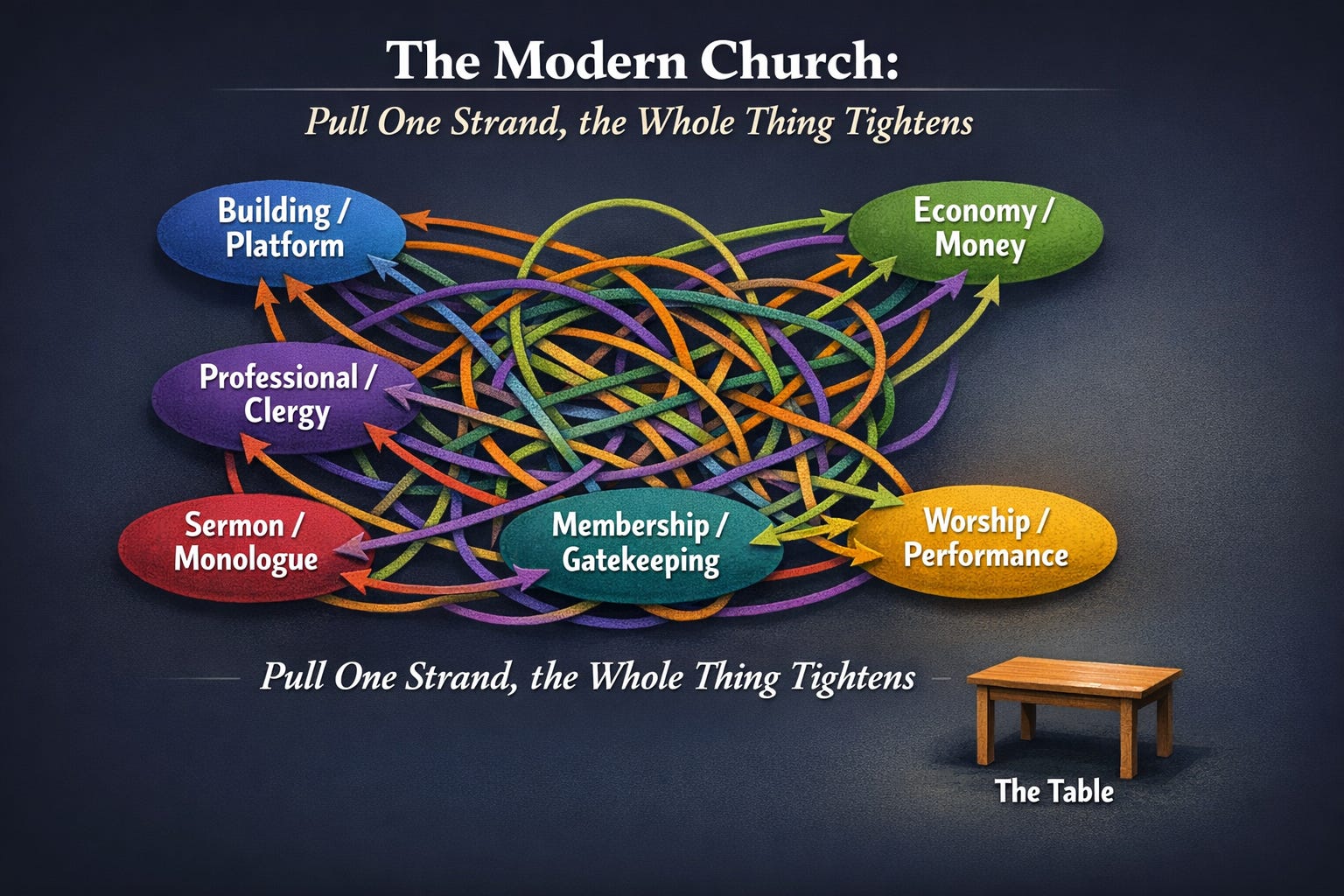
By now, the pattern should be visible. Programs are not isolated. They are part of the system.
Programs require the system. They require professionals (to lead them), buildings (to house them), budgets (to fund them), schedules (to organize them), and curriculum (to structure them). But most of all, they require scale. Large numbers. Large gatherings. Large structures.
Programs are a response to scale. They are a management tool. They organize what cannot function organically.
You might say: But we need programs to reach everyone. But different people need different things. But programs allow us to minister to diverse needs. And you’re right that we need to minister to all people. But programs don’t minister to people. They manage people. They organize people. They structure people. But the body ministers to people. It knows people. It responds to people. It serves people. Programs allow you to reach more people by managing scale. But the body allows you to reach people by being present. These are not the same thing. Paul’s “becoming all things to all people” was about identification and presence, not about creating different programs for different groups.
Each program creates another dependency. Another need for the system. Another justification for the building, the professional, the budget. Programs are not isolated. They are part of the system. And they serve the system by creating structure, dependency, consumers, and managing scale.
Accept the table, and you accept limits. Accept limits, and you reject the monopolized sermon. Reject the sermon, and you reject the professional. Reject the professional, and you reject membership. Reject membership, and you reject the building.
But what about programs?
Programs require the building. They require space, rooms, infrastructure. But if you’ve rejected the building, you’ve rejected all of these things. Programs cannot function without them.
Programs require the professional. They require leaders, experts, those with training and curriculum. But if you’ve rejected the professional, you’ve rejected the professional program leader. The professional program leader has no function the body cannot fulfill.
Programs require the economy. They require budgets, materials, curriculum, resources. But if you’ve rejected the economy, you’ve rejected all of these things. Programs cannot function without them.
But most of all, programs require scale. Large numbers. Large gatherings. Large structures. But if you’ve accepted the table, you’ve accepted limits. You’ve rejected scale. And without scale, programs are not necessary.
Each part depends on the others. Programs are not isolated. They are part of the system. And the system is one tangled ball. Pull one strand, and the whole thing tightens. Which is why reform always fails. And why only return works.
The Table and Ministry
So we return to the table. Not as a sacred object. As a place of one anothering. Knowing and being known.
The table is where ministry becomes visible. Not as programs. Not as curriculum. Not as schedules. As relationship.
At the table, you see the need. The brother who lost his job. The sister who can’t pay rent. The family who needs groceries. The child who needs attention. The youth who needs guidance. The man who needs accountability. The woman who needs friendship.
At the table, you don’t create a program. You respond. You serve. You share. You bear burdens. You use your gift. You meet the need. Not through a program. Through relationship. Through presence. Through the body functioning.
At the table, all ages are present. Children learn from adults. Adults learn from children. Youth learn from elders. Elders learn from youth. The body functions as a body. Without programs. Because the scale allows it.
At the table, you don’t need programs to see growth. You see growth because the body is functioning. You don’t need programs to see transformation. You see transformation because relationship is happening. You don’t need programs to see commitment. You see commitment because presence is required. The body functions as a body. Not through programs. Through relationship. Through presence. Through the body functioning.
At the table, ministry is not a program. It is relationship. It is presence. It is response. It is the body functioning. And it requires no program, no curriculum, no schedule, no professional, no building, no budget, no scale. Only relationship. Only presence. Only the body functioning.
At the table. Where ministry is not a program. But a way of life.
Yes yes yes! Agree!!! I found the silos/ministry programs become in competition with each other for time, money, energy and attention only decreasing the connection and relationship building. Our current system is broken, ineffective and expensive.
I'm ready to discover something new!!
But, but, but… the table will ruin my brand, my following, my pay-walled courses that are changing lives. I need more than just a table because God has really (I mean REALLY, really) called me to do great things and a table just ain’t enough for me, my stuff, my (errrr) kingdom that competes with the REAL Kingdom.